If you can’t say it in under 200 pages, is it really worth saying? These are our favourite pocket-rocket novels, guaranteed to deliver all the poignancy and punch of novels twice their length.
Mrs Caliban, by Rachel Ingalls

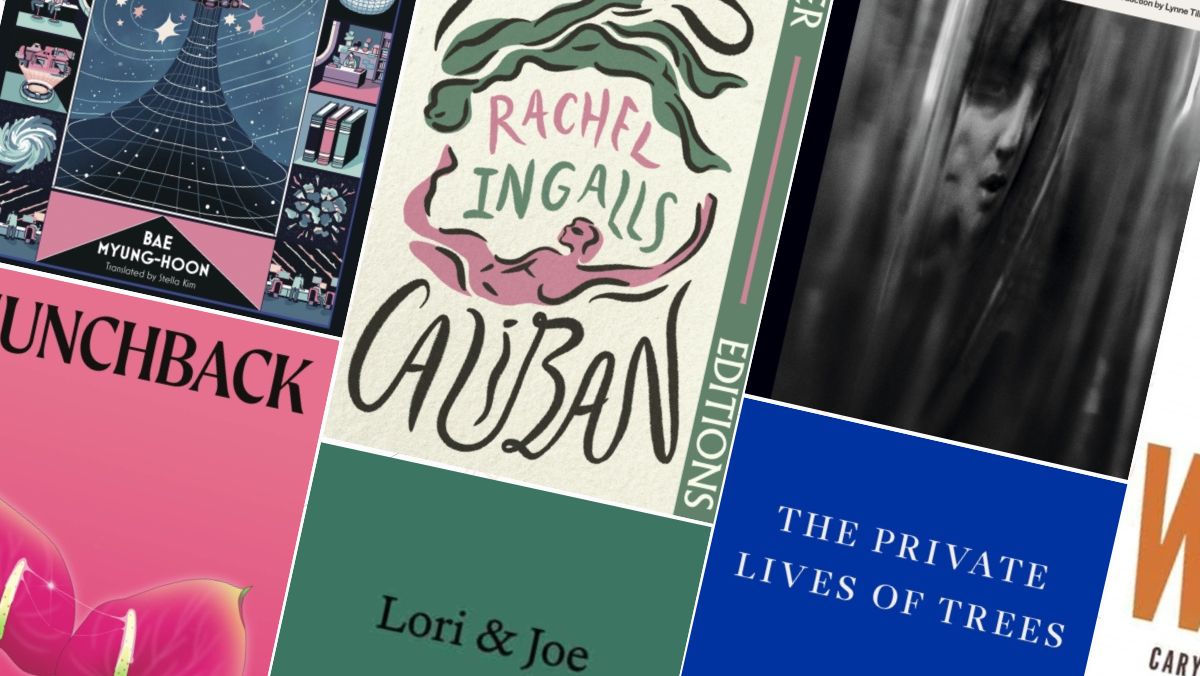
That’s right: a novella about an unsatisfied suburban housewife and her curious, sexy affair with a frogman (yep) on the run from his scientist captors. This is pretty much a perfect novel and we recommend it to people literally all the time. A weirdly funny yet devastatingly profound exploration of freedom, femininity and sexuality. FFO Shirley Jackson.
The Visitors, by Maeve Brennan

After the death of her mother, Anastasia seeks the solace of her paternal grandmother, Mrs King. Returning to Dublin and anticipating a warm embrace, Anastasia is instead cruelly rejected by Mrs King, who is reeling from the death of her only son – and Anastasia’s estranged father – some months before.
What then follows is a relentless game of cat-and-mouse: the more Anastasia yearns for reconciliation, the more unreachable her grandmother becomes.
Much like the fog descending across a wintry Dublin, ‘The Visitor’ is a claustrophobic read, yet Brennan succeeds in conveying the inescapability of generational trauma with a sparse delicacy.
Gloss, by Kyra Wilder

In chillingly observant and, at times, hilariously relatable prose Kyra Wilder captures the pressure towards, and compulsion against, presenting ourselves in narrowly defined ways. Loosely based on the Greek characters the Hespirides, Gloss follows Ari, Eleni and Hesper, three girls who meet at a therapy programme for women struggling with eating disorders.
Told from each girls’ perspective, and a greek chorus that entwines all three of their voices, Gloss thrums with a multivocal, and at times, hallucinatory narrative. The plot jumps between their stay at the treatment programme, ‘Golden Apples’, and events a year later, on the run up to a trial – the nature of which is only slowly revealed. In a kaleidoscopic and fragmented narrative of coercion, guilt and denial, what emerges is a gripping commentary on power and control.
Lori & Joe, by Amy Arnold

Set in the Lake District over the course of one day, it begins with Lori who finds her husband Joe dead in bed when she goes to take up their morning coffee. Instead of informing anyone, she sets out for a walk across the fells on a grey and foggy November day, and looks back on the day-after-day that represents an entire marriage.
We follow Lori’s memories as a stream of consciousness, but we become acutely aware of her on a bodily level; her aches and hunger, the desires and regrets that she feels deep in her body. Lori’s thoughts focus on the mundane, the everyday, the small niggles like Joe’s bike cluttering up the hallway, trying to dry the washing in the damp back room and watching the neighbour’s children through the kitchen window with feelings of resentment, longing and disappointment. So often her thoughts come back to the loneliness she feels and the repetitiveness of life, and this is reflected in the way that Arnold’s prose loops around and repeats phrases again and again. I found the style and the language completely captivating; Arnold takes us on a walk where the threat of danger lurks in the thick fog of the fells, and in the corners of the entrapped female mind.
A Leopard-Skin Hat, by Anne Serre (translated by Mark Hutchinson)

In the opening chapters of ‘A Leopard-Skin Hat’ the narrator is attempting to eulogise his friend, a troubled young woman named Fanny, yet speaks of his inability to write something ‘realistic’, instead choosing to fictionalise her life as he remembers it. In the act of memorialisation, what purpose does narration serve when in opposition to the truth?
Through a series of vignettes, we learn of Fanny’s inherent unknowability, her contradictory nature which both liberates and exhausts the narrator, and their deep attachment to one another. Yet, despite their closeness, the narrator finds a distinct intangibility within his friend: Fanny observes her landscape with an idiosyncrasy indecipherable to many. It is this desire to understand, therefore, that prompts the narrator to create stories of his own invention.
Mammoth, by Eva Baltasar (translated by Julia Sanches)

This is one of very few books that I’ve been inspired to read twice in quick succession! Eva Baltasar’s third novel in her loose trilogy is part twisted pastoral novel, and part feminist fable. Her protagonist, exhausted by life and work in the city withdraws herself further and further from human company, and sets up a new life in rural farmland. She is desperate for a child, but she has an equally almost animalistic desire for solitude, and a simple life where she can be reliant solely on herself. There’s an appealing sense of freedom in the simple, slow pace of life and the hunter-gatherer instinct to chop wood, bake bread and stockpile the cupboards, but Baltasar constantly reminds us that this is a life that cannot be sustained. This is a book that seizes you from the first page.
Hunchback, by Saou Ichikawa (translated by Polly Barton)

An absolute bolt of a novel. Saou Ichikawa lives with a congenital muscle disorder, as does Shaka, the main character in her debut novel.
Shaka lives in a plush care home paid for by her parents, from where she narrates the minute happenings of her daily life – the dropped morsels of food that take her incredible time and effort to retrieve from the floor, the processes and maintenance associated with her mucus-clearing apparatus, and the erotic short stories she secretly writes for an online audience. But once one of her care workers admits that he knows about all her secretive online activities, their relationship inevitably changes.
Polly Barton’s spiky translation delivers endless dark entertainment from Ichikawa’s original Japanese text, so many surprising turns of flippant language and visceral shocks with such precision and brevity.
At Night All Blood is Black, by David Diop (translated by Anna Moschovakis)

This is not your standard war book. At Night All Blood is Black is a blistering confessionary tale of Alfa, a Sengalese soldier fighting in the Great War on behalf of their French colonisers, and his descent into his own psyche. A mesmerising but gruesome novel of revenge. Come for the brilliant title (and Booker International Prize win!), stay for the utterly compelling mind of the narrator.
The Sky is Falling, by Lorenzza Mazzetti (translated by Livia Franchini)

It’s hard to resist this beautiful package that’s been firmly on our recommends shelf since it arrived. A tiny novel from Lorenza Mazetti, bound beautifully with illustrations from the author’s notebooks, translated by Livia Franchini and with an introduction from Ali Smith, it is literally a dream collaboration.
First published in 1961, The Sky is Falling is a fictionalised account of the author’s childhood under the fascist regime in WWII Italy. Penny, the wry and earnest young protagonist, has been sent with her sister Baby to live with their uncle after the death of their parents, and is forced to navigate her adolescence amongst the mounting tensions of war. Through Penny’s smart and witty observations, we see the anxieties of a terrifying world seen through a child’s lens. We are big fans of this style of auto-fiction, and would heartily recommend this for lovers of Tove Ditlevsen, Svetlana Alexeivich and Natalia Ginzburg.
Weasels in the Attic, by Hiroko Oyamada (translated by David Boyd)

It’s only 70 pages long but this novel is a gorgeous and tense little package – it seems whimsical on first glance but is actually strangely profound on masculinity, ageing, the passage of time. Two friends meet for dinner three times over a span of several years, and each dinner is characterised by life-changing junctures in the characters’ lives (marriage, fatherhood, weasel infestations etc). A read that lingers long after its ruthlessly efficient running time is over.
The Goalkeeper’s Anxiety at the Penalty Kick, by Peter Handke (translated by Michael Roloff)

A once-famous goalkeeper does a murder, then goes for a very long walk. OK, it’s more complicated than that. This bizarre and hypnotic 96-pager contains more philosophical insight than books ten times its length, and makes for troubling, scintillating company.
The Private Lives of Trees, by Alejandro Zambra (translated by Megan McDowell)

At risk of sounding like a broken record: Alejandro Zambra is a genius. We’ve been banging about our man for quite sometime now and if you haven’t jumped on the Zambra-wagon yet this is a great place to start, newly republished by Fitzcarraldo Editions. His second, vanishingly short but effortlessly brilliant and witty novella about literature and life set over the course of a single night.
Maud Martha, Gwendolyn Brooks

The only novel by poet Gwendolyn Brooks is the life story of Maud Martha rendered in tight but poetic vignettes through her earliest memories, first loves, first losses, coming-of-age and attempting to eke out a slice of that mid-century American promise: house, husband, kids, abundance. These are snapshots into a mostly ordinary life, but they come together to form something greater than the sum of its parts. Maud Martha is simply lovely. A miniature masterpiece.
Ghachar Ghochar, by Vivek Shanbhag

In just over 100 pages, Vivek Shanbhag manages to pack in a tense family drama filled with power hierarchies, class anxieties and psychological conflict. Set in Bangalore, the story depicts an extended family who are raised from near poverty to sudden wealth by an enterprising uncle, and the familial power balances that are shifted as a result.
The Alarming Palsy of James Orr, by Tom Lee

A man wakes up to find half his face has fallen. His family, his work, his social life, his inner life: all of them take a beating in this slight but mighty and darkly comic work which also deliciously satirises the mundanity and politics of British suburbia.
West, by Carys Davies

An impossibly epic, unashamedly widescreen Western adventure about the daughter of a man who is convinced he’ll find fame and fortune across the other side of America. We see through her eyes the impact of his decision, the adventure, the abandon, the wreckage and the implications.
The Wind That Lays Waste, by Selva Almada (translated by Chris Andrews)

A priest and his daughter break down in the Argentinian desert and bump into a mechanic and his son. A night passes. Existential things happen. It’s very warm indeed.
Ti Amo, by Hanne Ørstavik (translated by Martin Aitken)

Quite hard to sell this one based on the plot alone, but here we go: Ti Amo is the story of a married couple who are in the process of facing up to the husband’s decreasing lifespan after a cancer diagnosis. It’s not cheery. But it is so incredibly well written, heart-explodingly sad, exploratory in execution, concise as possible (90 pages!) and just incredibly brave. No thought is edited from the voice of our narrator, the incomprehensible is made perfectly clear, shocking internal tumult and upset captured in sympathetic and aching prose. Will definitely be on my books of the year list, even if it is a difficult sell. Fans of Deborah Levy will find much to enjoy, but this is unique, hard to categorise, hard to love, but you WILL love it.
The Appointment, by Katharina Volckmer

Caustic and sharply hilarious, this merciless and perfectly formed novelette is one brilliant monologue, the results of a woman’s single appointment with her doctor – expect blazing ruminations on shame, sex and squirrel tails.