Here are some of our favourite weird sci-fi books, spelling out the big stuff in life through the medium of spaceships and aliens and freaky goings-on (all of which we heartily endorse).
Aerth, by Deborah Tomkins

This is one of those “I don’t know how you pulled this off” books. It’s a concept that’s so ambitious and Deborah Tomkins not only seriously delivers on that concept but dives deeper and deeper into it. It’s also one where the less you know, the better, because it goes in directions that are so unexpected and brilliant.
But to give a little back-of-the-envelope pitch, Aerth follows the life story of Magnus from childhood through his life via a series of snapshots through his life on Aerth, an seemingly edenic, non-hierarchical Earth-ish planet (near-future society?) slowly descending into an ice age, through to his life travelling to Urth, its newly discovered twin planet where another seemingly human society has evolved in parallel.
If you’ve read and loved The Dispossessed you’re in for a treat, because this feels like a gentle nod to Ursula K Le Guin’s masterpiece if she’d written it in 21st century Britain.
Science-fiction lovers rejoice, but if you’re not a sci-fi person this is still for you – just trust me.
FFO Ursula K Le Guin, well-executed eco-fiction, epics-in-miniature
The Proposal, by Bae Myung-Hoon (translated by Stella Kim)

We’re long-time Bae Myung-Hoon fans here at Storysmith (‘Bae-Watchers’, as we’re collectively known) And ever since his fantastic near-future sci-fi short story collection Tower was translated from Korean by Stella Kim and published by Honford Star a few years back, we knew we were in for the long haul.
However, if you feel slightly allergic to the “sci-fi” label, though, as I know many people are – don’t worry too much. BMH’s books are undeniably sci-fi, but they’re relatively light on the “sci-” part and more in the “soft-sci-fi” realm. The Proposal is a space opera set during an intergalactic war with a mysterious faceless enemy that a prophetic text predicted would attack on a specific future date. But the main crux of the story is based around: 1. A long-distance relationship between our protagonist, who is space-born, and an earth-born woman; and 2. the bureaucratic hijinks that ensue through space and time as humanity grapples with an unknown enemy which is so far away they can’t even shoot them properly, because by the time the “lucifer particles” reach their spaceships it’s 20 minutes later and they’re no longer in the same point in space.
Bae Myung-Hoon’s signature bizarre-comic style makes this a one-or-two sitting book that will ultimately sucker punch you with some bigger observations about the human condition. We absolutely blasted through it.
Dawn, by Octavia E Butler

Dawn is nothing short of mindblowing. I don’t want to go into too much detail, because I went into this one totally cold – and all the better for it! The blurb won’t spoil too much, but I said just dive in!
But here’s a few things: I’ve never read anything that confronted the divide between human and non-human so vividly; I’ve rarely read anything that had such a profound moral dilemma at its core. Octavia Butler tackles colossal themes with seeming ease. Even if you’ve read some of her more famous novels, you’ve got no idea what’s coming for you in this baby!
Nova, by Samuel R Delany

What a book! Our lead, Cpt. Lorq von Rey, is on a mission to steal the universe’s most valuable resource from the heart of an exploding star, and in doing so he’ll topple the balance of power that governs the galactic order.
If he is the Captain Ahab of this space-age quest for revenge, the crew of the Piquad are his ensemble cast of cyborgs: waifs and strays from all parts of society including a drifter-cum-musician nicknamed “The Mouse”, a slightly pooterish Harvard graduate, a Tarot-reading mystic, and two thirds of a set of triplets.
I’ve been working my way through the Samuel R Delany backlist (which, by the way, is full of absolute stonkers). This is the most enjoyable yet. If you like your economic-political intrigue, deep philosophical ponderings, and literary geniusness wrapped up in a rip-roaring space adventure wrapper, then this one’s for you.
This Is How You Lose The Time War, by Amal El-Mohtar and Max Gladstone

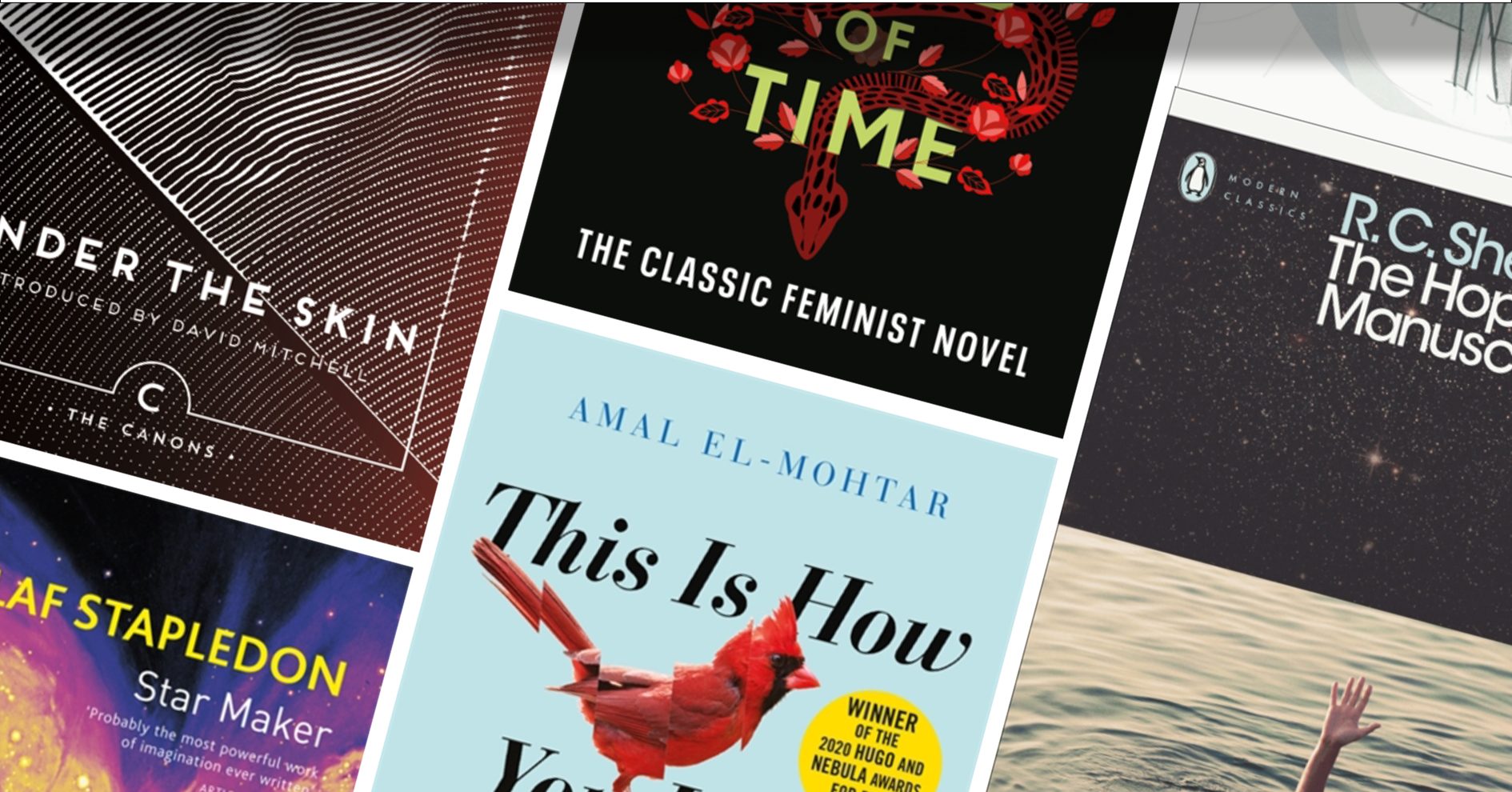
Two time-travelling secret agents in the throes of a galaxy-ending war exchange interdimensional love letters, and you get to read them all. Heartbreaking and eye-opening and unique.
The Employees, by Olga Ravn (trans. Martin Aitken)

A fragmentary novel told through unlabeled and uncategorised statements from employees of the Six-Thousand Ship, a spaceship on an unknown task in the far-flung depths of the galaxy. Out of these interviews, Olga Ravn constructs a subtle and beguiling novel, probing questions of intimacy, humanity, and the future of human labour in a non-human future.
The Lathe of Heaven, by Ursula K Le Guin

The most Philip K Dick-esque or even Vonnegut-like of Le Guin’s novels (in initial concept anyway – no one writes quite like Le Guin and certainly not with her steadfast moral and philosophical weight). In a near-future, semi-dystopian Portland, Oregon, our protagonist George Orr can change reality with his dreams. The whole fabric of reality changes on a chapter-by-chapter and page-by-page basis into wilder and wilder realities as the hubristic psychologist, Dr Haber, manipulates George for the attempted betterment of humanity… maybe?
Woman on the Edge of Time, by Marge Piercy

Simply put, Woman on the Edge of Time is a masterwork of feminist science-fiction. While unfairly institutionalised, Connie flits in and out of the present: from the dystopic but not-so-unfamiliar world of 1970s New York, to the possible society of “Mattapoisett”–a decentralised, classless, and gender non-conforming vision of the future.
Under The Skin, by Michael Faber

A compulsive and shocking reading experience, Faber’s modern classic about a woman who stalks the roads looking for hitch-hikers is a genre-sliding sci-fi mystery that will undoubtedly stand the test of time.
We, by Yevgeny Zamyatin

Written as a letter from a spaceship engineer named D-503 to a future and potential alien race, WE depicts the world of “The One State”: a mega-city made entirely of glass whose citizens, known as numbers, live according to exacting mathematical principles. An ambitious dystopian novel that preceded and inspired both Orwell and Huxley.
Star Maker, by Olaf Stapleton

Possibly the most ambitious concept for a novel ever devised. Starmaker is a future history of the entire universe from beginning to end, as narrated by the disembodied mind of a human narrator. Merging with other enlightened minds along the way, the novel snowballs to a larger and larger scale, on route to the climax of all creation: the meeting of an all-encompassing cosmic mind and its creator, the Starmaker.
The Hopkins Manuscript, by R.C. Sherriff

The Edward Elgar of science fiction, R.C. Sherriff’s gently haunting document of one ordinary man’s way through a climate-altering disaster is stunningly prescient and beautifully written, sort of like Diary Of A Nobody meets The Drowned World.
Tower, by Bae Myung-hoon (translated by Sung Ryu)

Beyond the absolutely exquisite cover, Tower ticks all the boxes. It’s a collection of interconnected science fiction short stories, translated from Korean, all set in the fictional sovereign nation of Beanstalk, a 700-storey mega-skyscraper. It is slapstick, and farcical, and really funny but comes with a good dollop of political commentary. Most of all, Tower strikes that perfect balance that every good collection should: each story stands on its own two legs as a coherent, complete story, while the book as a whole has a narrative strand running through it that makes it read more like a novel. Perfecto!