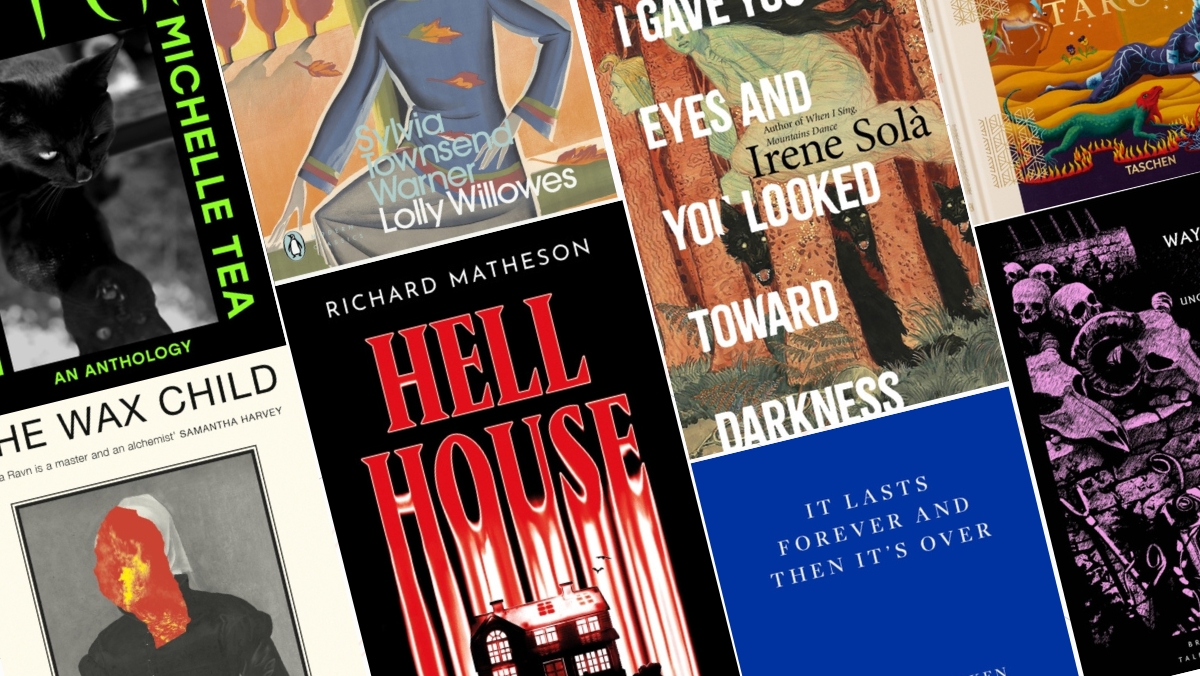
To quote the immortal words of The Mamas & The Papas: all the leaves are brown and the sky is grey. Spooky season is upon us which means one thing and only one thing: spooky reads. Here’s a roundup of our favourites be they absolutely bloodcurdling or just pretty dang autumnal. Choose your spook level accordingly!
Hell House, by Richard Matheson

You’ve probably heard us banging the Matheson drum many times before. He is, simply put, the genre-defining American horror writer. If you haven’t heard of him, you’re probably still familiar with his work in a second-hand sort of way. A major influence on heaps of writers such as Stephen King, writer of many of the most iconic episodes of The Twilight Zone, endlessly adapted to film and TV, Matheson’s fiction is the perfect blend between classic and genuinely shocking.
Hell House is the cult classic haunted house novel to top all haunted house novels. It ticks all the boxes. We’ve got an unlikely cast of strangers (a mixture of dyed-in-the-wool sceptics and supposed clairvoyants) hired by an eccentric dying millionaire, hoping to solve the question of life after death conclusively before the end of the week by staying at the Everest of haunted houses: a building once owned by the satanic, perverted cult leader Emeric Belasco, and a history so deeply depraved that few have since entered and lived to tell the tale.
Caesaria, by Hanna Nordenhök (translated by Saskia Vogel)

For anyone who was beguiled by the film adaptation of Alasdair Gray’s Poor Things, we present to you an altogether scrungier, more dilapidated and terrifying version of a coincidentally similar set-up.
Caesaria is the only ‘daughter’ of a gifted but absent surgeon who specialises in the operation that gave her the name, held in a crumbling mansion with no chance of escape. As she explores the grounds, tethered emotionally (and sometimes physically) to the house itself, her experiences of the world and its mystifying inhabitants become more complex and unsettling. The atmosphere is utterly spellbinding, the frights are elemental, the writing is lyrical and unusual throughout – a delicious read for the darkened evenings.
Our Share of Night, by Mariana Enriquez (translated by Megan McDowell)

It might be 700 pages long, it might be deliriously, psychedelically gruesome, but it is also one of the most deeply involving novels you’re likely to read. The sheer length and extremity of the material only serve to highlight what a work of intense craft and construction it really is. Gaspar is a special boy, born into a family bound by a generations-long occult obsession, one that his father has tried to protect him from across a period of decades. Intergenerational drama, shocking outbursts of nightmarish violence, trippy Jodorowskian visuals, an ingenious weave through modern Argentinean history: it’s got everything you could possibly want from a book with a gigantic claw on the cover.
The Wax Child, by Olga Ravn (translated by Martin Aitken)
It’s 1620, the year the Wax Child is born, or, more accurately, is shaped from beeswax and brought into the sentient world by witchcraft. This Wax Child, cradled by her maker Christenze Krukow, watches and listens as Christenze and a small collective of women spin flax, mend garments, pickle herring, and cast spells. Drawing on fable and folklore, these women form a bond with each other, with the earth, and with a realm beyond most humans’ meagre understandings.
But, existing outside of the realms of patriarchal, religious and heteronormative norms, it’s only so long before this group become regarded with suspicion. Superstitions quickly turn into malicious accusations of wicked dealings with the devil; and these accusations quickly turn into violence, arrests, and brutal executions. All the while, the Wax Child watches, chronichilling events as they unfold around her. Collecting information from the viscous world, spinning a story from wax, teeth, fingernails, and ink, she bears witness to these women, their glee, wisdom,and power, and the vehemence they face at the hands of fearful ignorance.
The Wrestler by John Kenn Mortensen

If you want nightmares, John Kenn Mortensen (“JKM” to those in the know) is your guy. You may know him as co-author of Storysmith Deepcut The Christmas Bestiary, the most horrifying Yuletide book imaginable. The Wrestler is his graphic novel debut: a super short fable about an ageing alcoholic wrestler named Sledgehammer, who may or may not have made a deal with Satan himself in exchange for invincibility in the ring.
The Wayfarer’s Weird: Wild Tale of Uncanny Rambles (edited by Weird Walk)

The British Library Tales of the Weird anthologies always deliver, especially for reading during the darker months… This is the second of their weird fic/horror anthos edited by the people behind Weird Walk Zine, combing the British Library archives for stories that sit in the centre of the spooky/rambling Venn diagram. The perfect stuff-in-the-coat-pocket book before you disappear across the fields.
The Empusium, by Olga Tokarczuk (translated by Antonia Lloyd-Jones)

Appropriately subtitled ‘A Health Resort Horror Story’, the much-anticipated novel from Nobel-garlanded queen of everything that is good in this literary realm Olga Tokarczuk is a gleefully sadistic tale.
Assembled in the clear-aired mountains of Silesia at a dedicated ‘Guesthouse for Gentlemen’ in 1916, a bunch of doofus men with respiratory issues peck and pontificate around the case of the guesthouse owner’s recently-deceased wife. Aided by the potent local liqueur, the men become increasingly haunted, and newcomer Mieczysław battles to retain his physical and mental fortitude. Fans of Drive Your Plow will feel a familiar unease, but this time the terror is more pronounced, more directed, more political in its roots. Part mystery, part deconstruction of misogyny, part gung-ho horror, all Olga!
Monstrilio, by Gerardo Sámano Córdova

After Magos’s 11-year-old son dies, she cuts out a piece of his lung, puts it in a jam jar, and starts to feed it. As a startling meditation on grief and its embodiment, the lung starts to grow, taking on a sentience of its own and becoming Monstrilio. Not quite human, not quite monster, Monstrilio tests the limits of familial connection and vitalizes the development of a strange and monstrous love. Tender and funny, but at moments startling profound, Monstrilio is a wily meditation on grief, reinvention, and restoration.
Something Wicked This Way Comes, by Ray Bradbury

The perfect October novel. Small-town America. Boys on the cusp on manhood. A mysterious carnival comes to town in the week leading up to Halloween… A real Stephen King-esque feel to everything.
Bradbury is an absolutely unparalleled writer. His stories are simultaneously classic, familiar, and totally original and genuinely thrilling. I read one of his books most autumns and have absolutely zero regrets.
Come Closer, by Sara Gran

Of course, being scared out of your wits is a divisive experience – personally, we love to be unsettled, but even if the idea of intentionally scaring yourself is something you can’t even contemplate, we think this might be the book to change your mind.
Written back in 2003 but reissued beautifully here, Sara Gran’s tale of a woman’s gradual unhinging feels strangely historical, almost pre-internet, something from an analogue age.
Our narrator, Amanda, begins the novel finding that she’s deeply insulted her boss over a very trivial matter, crucially, without really knowing that she has. Her personality begins to slip, her actions become erratic, her relationships start to suffer, and there’s a constant tapping noise in her apartment. You could even say it’s predictable, but the way in which Gran’s novel absolutely propels through the motions makes Come Closer a devilish delight. We won’t spoil the reasons behind Amanda’s sudden change in character, but this is a real shut-the-book-to-keep-yourself-safe reading experience, brilliantly constructed and somehow still hugely fun.
It Lasts Forever and Then it’s Over, by Anne De Marcken

This is a zombie novel like no other. The narrator, a member of the undead, wanders through her new reality. Recounting the details of this life-after-life, she composes a literary narrative as she herself physically decomposes, literally, losing her arm within the first 20 pages. Our undead narrator’s internal monologue, along with the brusque interruptions from the corpse of a crow that lives inside her chest, try and make fashion a world from an apocalyptical waste-land. It’s this tension between composition and decomposition that helps hold this strange and spare novel together.
It Lasts Forever and Then it’s Over asks the question of what makes us, even as we are being unmade.
I Gave you Eyes and you Looked Toward Darkness, Irene Sola (translated by Mara Faye Lethem)

In a remote farmhouse in the Catalonian mountains, we meet Bernadeta, lying on her deathbed. But she’s not alone; she’s surrounded by all the women who have ever lived and died in the house, now ghosts, preparing to welcome the newest member to their party.
The story unspools each woman’s memories, revealing stories filled with beasts, demons, and disastrous pacts with the devil. The house enacts a past and present in continuous motion, in a dance between living and dead in which the boundary between the two is continually blurred.
It’s a feast of Catalonian folklore verging on horror, but it has a unique beauty through Sola’s vivid and poetic lens.
A Sunny Place for Shady People, by Mariana Enriquez (translated by Megan McDowell)

Ok, ok, so we won’t shut up about how much we love Mariana Enriquez. But it’s for good reason. She’s the reigning queen of the realm of all things literary horror.
And, for us, reading A Sunny Place for Shady People is like putting on an enormous comfort blanket – if your idea of comfort is a macabre place full of ghosts, supernatural beings and general terror.
Childhood friends connected by traumatic events at a site for disused refrigerators, a family inflicted by disappearing facial features, a neighbourhood driven mad by restless and angry ghosts, these stories exist just on the boundaries of what is real. The magic of Enriquez’ stories, for me, is that the settings and the characters feel incredibly real, there’s no hamming up of spooky details, and the everyday settings make the surreal elements all the more chilling. If you’re a stalwart Mariana fan, or coming to her work for the first time, A Sunny Place for Shady People is a delightfully horrifying treat.
WITCH, edited by Michelle Tea

Brand new anthology of writing on witchiness and the occult, edited by the Michelle Tea (editor of SLUTS, author of Modern Tarot, Modern Magic, Valentia, Against Memoir, Black Wave). Besides being a fantastic writer in her own right, Michelle Tea is also a real conduit of other writers and artists. This particular coven includes essays by CAConrad, Frankie Miren, Sarah Shin, Edgar Fabian Frias, Amanda Yates Garcia, Ashley Ray, Brooke Palmieri, Yumi Sakugawa, Kai Cheng Thom, Ariel Gore, Myriam Gurba, Fariha Roisin, and many others.
Lolly Willowes, by Sylvia Townsend Warner

An early feminist classic. As the generations go by, “Aunt Lolly” lives in the shadow of each successive Willowes patriarch, slowly subsumed into the confines of familial duty and a stuffy, frigid post-Victorian moral sensibility which she tacitly rejects. Approaching middle age, she suddenly decides (to the horror of her relatives) to move to the Chilterns for a life of solitude, freedom and… witchcraft! A perfect, witty modernist novel and a thorough rejection of society’s expectations of women
Poor Things, by Alisdair Gray

Godwin Baxter, or Poor Thing’s very own Frankenstein, creates the monstrous Bella Baxter, a corpse who is brought to life with the brain of her unborn child inside her adult body. Yes, it’s as bizarre and brilliant as it sounds. Playing with hybrid bodies (both physical and formal), the narrative is a strange amalgamation of Gray’s own illustrations, narrator’s letters, diary entries and newspaper excerpts. Inhabiting many multiform and ‘monstrous’ bodies, Poor things is able to erode the boundaries between right and wrong, truth and lies, human and monster. Through this unconventional form, Gray is also able to parody the bodily and societal constraints of Victorian Scotland. Entirely unaware, and unrestrained, by the societal constraints put onto her female body, Bella’s freedoms and sexual liberations shake the world around her.
Beloved, by Toni Morrison

A much beloved classic (sorry). But seriously, Toni Morrison is well worth everyone’s time. Beloved is a richly imagined haunted house novel and gothic masterpiece. It’s a ghost story in the literal sense – the titular Beloved (named because that was the only word on her grave) is the embodied spirit of a long-dead child – and in the metaphorical sense: it’s a ghost story about America’s moral skeletons-in-the-closet.
Tarot: the Library of Esoterica

An absolutely mammoth book of all things Tarot, and maybe one of the most deliciously indulgent books to buy for yourself during Spooky Season. This is both an extremely thorough reference book and guide (you’ll find notes on all the cards’ meanings, associated elements, symbology, histories, practical tips) and an eye-wateringly beautiful coffee table book to gaze at by candlelight, flick through, while sipping some sort of herbal tea, black cat on lap… You can picture it, I’m sure.
If this a bit too intimidating a tome, though, Taschen have just published a smaller edition. It’s less in-depth but more practical for taking about with you when you’re doing readings on the go!