If you haven’t yet had the chance to behold Latin America’s literary vistas, you’re in for a treat—albeit a selection of supernatural, beguiling, and downright dark treats. Here are some of our favourite novels, novellas and short stories from Argentina, Brazil, Mexico, the Caribbean, Chile and beyond.
Not A River, by Selva Almada
(translated by Annie McDermott)

Set on the Paraná River in Argentina, Not a River follows the fishing trip of Enero, El Negro, and Tilo. After catching and killing a giant ray, they seem to have disturbed something, intruding upon a wider, delicate ecology of which they’re not part. The choric quality of the narration interweaves the intruder’s voices with those of the local inhabitants; in fact, Almada’s prose skillfully interweaves the past with the present, the living with the dead, the human with the animal. Annie McDermott’s translation adds to this poetic quality, creating a soundscape of half-rhymes and echoic murmurs. It’s a novel that seems to ripple, like the river that runs through it, with many undercurrents and tributaries, seamlessly connecting past and present, surface and depths.
May God Blast the Woman Who Writes About Me, by Aura García-Junco (Translated by Heather Cleary)

Our female narrator tries to (re)negotiate her relationship with her late father through his book collection. Her small flat becomes inhabited by an inherited mass of books, that both allure and repulse her in equal measure. Upon opening their pages, she’s confronted by literary snapshots of her fathers identity and the kind of life he prioritised. Equally, she is confronted by their father-daughter relationship, his absences, her grief, and, above all, their uncomfortable similarities. At once memoir, fiction, and essay, Aura García-Junco’s prose collects together family history, literary and theological references, wry humour and desperate grief.
Still Born, by Guadalupe Nettel (translated by Rosalind Harvey)

I adored this novel! It’s such a multifaceted look at motherhood from many different stances, and in Nettel’s hands it feels completely authentic and entirely unsentimental. It poses important and difficult questions about whether or not to have a child, whether life without children can be fulfilling, and what happens when complications and tragedies arise in pregnancy and motherhood. It’s a novel about the freedom of choice, and the nuances of what we call and label motherhood. Nettel’s style is plain and direct, but she makes the reader feel so much, I found some parts of the novel almost unbearably moving, but she kept me completely glued to the page.
For fans of Breasts and Eggs & No-one is Talking About This.
Crooked Plow, by Itamar Viera Junior
(translated by Johnny Lorenz)

Exposing the exploitation of tenant farmers and Afro-descendent communities in Brazil’s north-east, Crooked Plow tells the beguiling and beautiful story of Bibiana and Belonisia, two sisters from Seratao, in the country’s underrepresented backlands. Through glittering and poetic prose, Vieira Junior tells the haunting story of a mysterious knife that ties these sisters’ lives (and voices) together. Not only are the sisters’ voices interlaced, but Vieira Junior weaves their stories into the land, the land on which they rely, both for economic necessity, and as a repository for their increasingly disappearing histories. Combining magical and social realism, Viera Junior plays with voice and voicelessness, asking who has the power to speak.
Our Share of Night, by Mariana Enriquez
(translated by Megan McDowell)

It might be 700 pages long, it might be deliriously, psychedelically gruesome, but it is also one of the most deeply involving novels you’re likely to read. The sheer length and extremity of the material only serve to highlight what a work of intense craft and construction it really is. Gaspar is a special boy, born into a family bound by a generations-long occult obsession, one that his father has tried to protect him from across a period of decades. Intergenerational drama, shocking outbursts of nightmarish violence, trippy Jodorowskian visuals, an ingenious weave through modern Argentinean history: it’s got everything you could possibly want from a book with a gigantic claw on the cover.
Chilean Poet, by Alejandro Zambra
(translated by Megan McDowell)

Having happily devoured most of his exquisite backlist (the word “Zambra-naut” has been bandied around), I can say with certainty that Chilean Poet is Alejandro Zambra at the top of his game. Starting as a coming-of-age story for the aspiring (and quite bad) poet, Gonzalo, it ventures into more comings-of-age as the novel progresses: Gonzalo has a coming-of-dad when he reunites with his high school girlfriend and becomes a sort of step-dad to her son, Vicente, who himself has his own boy-to-(failed)poet-to-man arc.
Sweeping in scale yet closely observed in Zambra’s trademark ironic-yet-profound style, this is the perfect balance of literary virtuosity and juicy narrative fiction. Up there in our all-time favourites.
What is Mine, by Jose Henrique Bortoluci (translated by Rahul Bery)

What is Mine is my favourite kind of non-fiction book. The kind that blurs boundaries between memoir and history and cultural enquiry, and jumps around between past, future, tying together its themes and subjects in unexpected ways.
What threads What is Mine together is a series of interviews with Didi, José’s father, who worked as a truck driver in Brazil over a tumultuous half-century of dictatorship, but who, in a lot of ways, has very little to show for it and little to no inheritance for his children: no diaries, no photos, no money or estate to pass on. The best anecdotes include his UFO experience, how to cook roadkill on a ripping hot engine, and the other truckers he knew from a life on the road. But on a macro-scale we also witness Didi’s part in the construction of the trans-Amazonian highway, a supposedly country-unifying municipal project, with complicated colonial roots and devastating environmental consequences. What results is a nuanced and compassionate analysis of capitalism, colonialism, Brazilian history, illness, family and masculinity.
The Hour of the Star, by Clarice Lispector
(translated by Benjamin Moser)

There’s truly nothing better than a delightfully unreliable and unpleasant narrator, à la Otessa Moshfegh. But this time, it’s metafictional! Our narrator is the tortured and philosophical Rodrigo, who also claims to be the author of this very novella (and yet not at all responsible for the fate of its characters, just so you know. They’re not real anyway, so could you stop asking? There’s nothing he can do about it!)
Hurricane Season, by Fernanda Melchor
(translated by Sophie Hughes)

Uncompromising, bewitching, troubling and strangely beautiful, we were bowled over by Mexican writer Fernanda Melchor’s first novel to be translated into English. A twisted murder mystery that reveals the inner workings of village life in disturbing, psychedelic and unnerving ways.
This is Not Miami, by Fernanda Melchor
(translated by Sophie Hughes)

Ok we’re cheating a bit doing Fernanda twice, but you’ll just have to forgive us. Anyone who’s already read Fernanda Melchor’s fiction will know that the Mexican writer does not hold back in dealing with the murkier side of urban living. This collection of short and explosive stories is based in fact but relayed variously as reportage, investigative journalism and almost novelistic accounts of foul deeds in the city of Veracruz, where Melchor has found endless and fruitful inspiration. Inter-gang relations, tragic crimes borne of societal decay, and an incredible central story that begins in a haunted house and quickly becomes a terrifying curbside exorcism – these stories do not flinch, and so they’re perhaps not for everyone. But if you have the mettle for the details then you’ll find the manner in which they’re conveyed absolutely captivating.
When Women Kill, by Alia Trabucco Zeran
(translated by Sophie Hughes)

Female murderers are irresistably fascinating, and this Chilean curio deals with the central theme of its title in a brilliantly creative way, turning the tropes of ‘true crime’ into something rather more profound than merely glamorising the four women it profiles. Detailing their shocking crimes and the repercussions with commentary on the research process itself, Zeran’s methods are exhaustive but eminently readable. A delightful twist on the usual killer commentary!
Sevastopol, by Emilio Fraia
(translated by Zoe Perry)

Three brief, beguiling stories from contemporary Brazil, taking inspiration from Tolstoy’s Sevastopol Sketches. Fraia renders his characters in a seamless, almost cinematic prose, taking us on a deep dive into their most candid moments of self-reflection.
The Twilight Zone, by Nona Fernandez (translated by Natasha Wimmer)

It’s 1984, in Chile in the middle of the Pinochet dictatorship. The novel concerns, or rather is concerned with, a member of the secret police who walks into the office of dissident reporters and insists on giving his testimony. ‘I tortured people’, he says, and proceeds to describe the multiple horrors he was involved and complicit in. The narrator was a young child when this article was released, and remains haunted by it for the rest of her life. Here, she imagines the man’s present and past, based on the facts she knows, and reckons with the ways his own history interacts with and intersects with hers. It’s about the politics of history, whose stories get told and what gets remembered, about resistance and survival and friendship. And obviously, it’s absolutely brilliant.
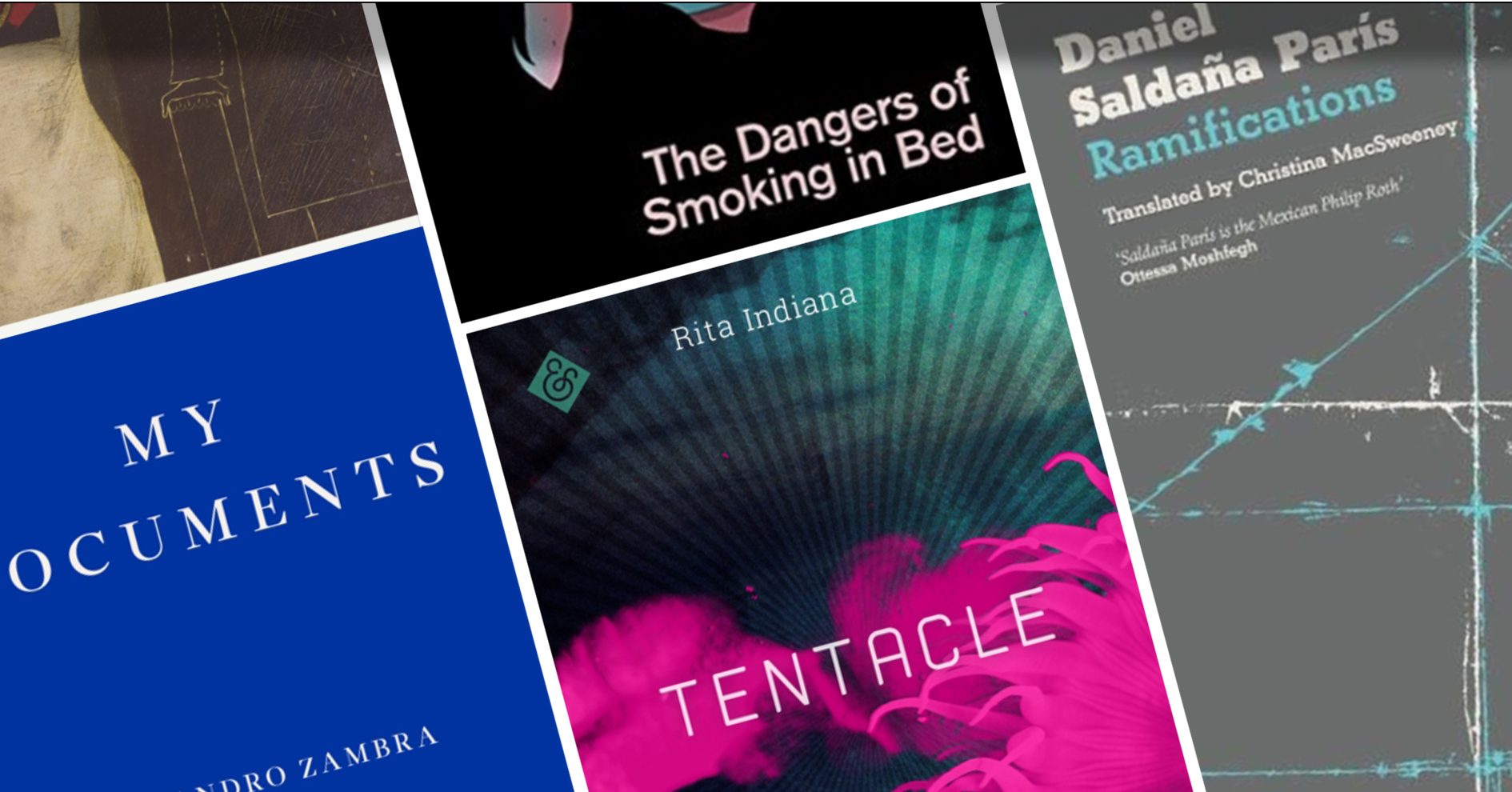
Tentacle, by Rita Indiana
(translated by Achy Obejas)

A queer, punk, post-apocalyptic novel from the Carribean, featuring time-travel, mystical sea anemones, gender-swapping, art theory and a prophecy to save the world. Unbelievably, this runs under 200 pages.
Elena Knows, by Claudia Pineiro
(translated by Frances Riddle)

An agonizingly good novella set over the course of a single day. After Rita is found hanged in the local church, Elena refuses to believe her daughter died of suicide. Hampered by the ebbs and flows of her Parkinson’s disease, Elena embarks on a torturous journey to the other side of Buenos Aires looking for answers. For fans of Drive Your Plow Over the Bones of the Dead and Death in Her Hands. “
Ramifications, by Daniel Saldana Paris
(translated by Christina MacSweeney)

A washed-up, depressed and unemployed writer obsessively relives and rewrites the details of his early childhood: his mother’s disappearance to join the Zapatistas, his own tortured and obsessive internal world, and a cross-country coach journey to the other side of the country in search of answers. Daniel Saldana Paris writes with an impressive attention to detail, creating a near perfect portrayal of a child’s interior life.
The Adventures of China Iron, by Gabriela Cabezon Camara
(translated by Iona Macintyre & Fiona Macintosh)

This is a book that will transport you to the dusty plains of the Pampas in 1872, evoking the excitement of wind-in-your-hair journeys, the joy of discovery and the freedom of travel. It’s a journey of unlikely friendships, rich cultural discovery, sexual awakening and British customs in the wild and endless Pampas (Liz seems to be able to produce un-ending tea, whisky, umbrellas and other luxury items from the depths of the wagon). You’ll be swept up by the sense of freedom and you will punch the air in celebration of China Iron’s joyful and liberating journey.