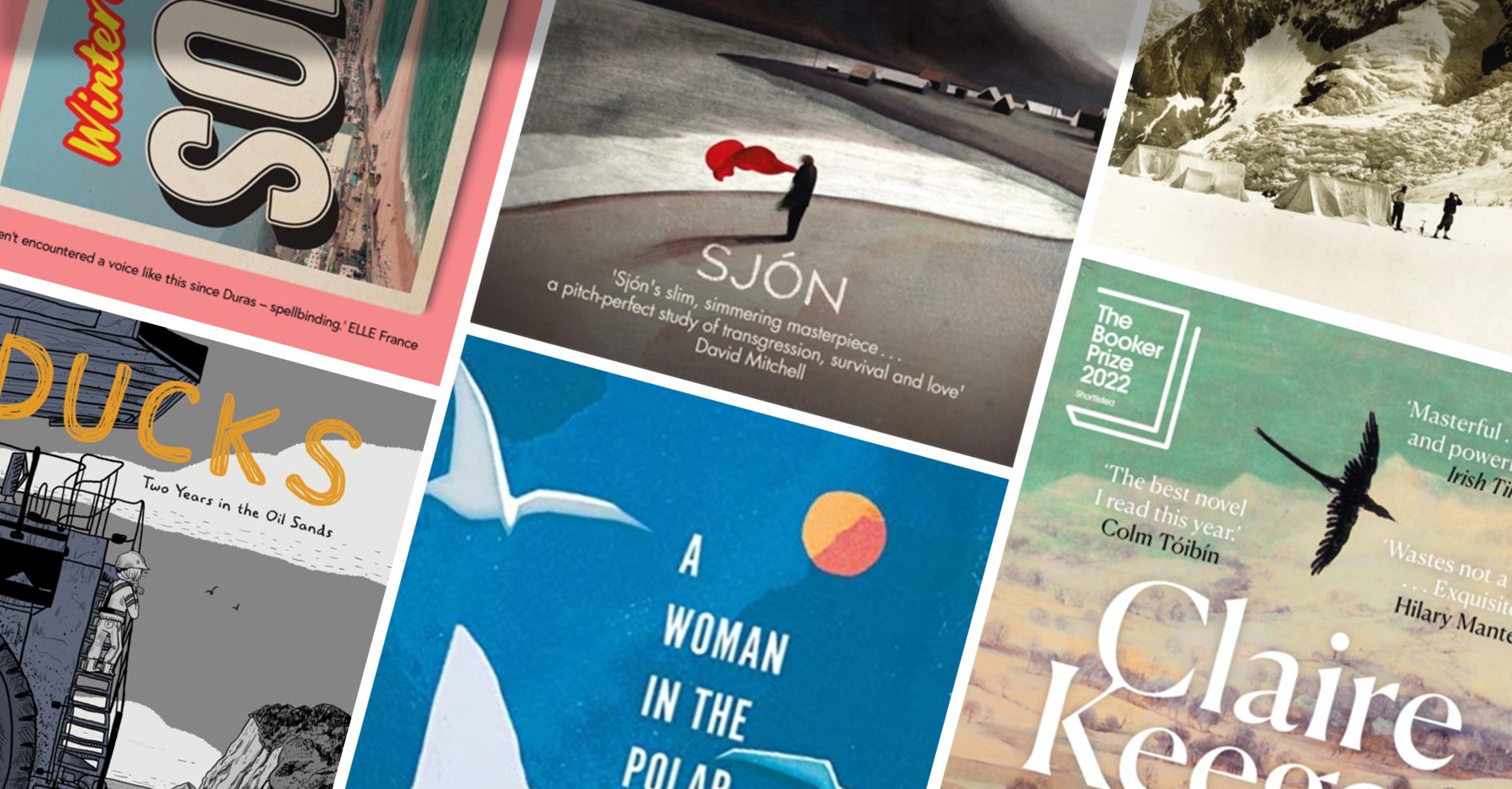
We love a fireside read as much as the next person, but even the most roaring and well-stoked woodburner will struggle to take the edge off these chilly tomes. If you like to feel the biting cold drift from the page to your fingertips, you need all of these on your shelf.
We Do Not Part, by Han Kang
(translated by e. yaewon & Paige Aniyah Morris)

It’s fair to say Han Kang is ‘having a moment’, as they say. For years she’s been a darling of the literary community, but late last year she pocketed the ultimate gong: the Nobel Prize for Literature. Few could argue that this isn’t a well-deserved accolade, as her oeuvre has somehow maintained that magical balance between accessibility and profundity, without veering too far in either direction.
And with We Do Not Part, an aptly chilly read for the start of the year, she has created an unexpected synthesis of unsettling thriller and deeply human examination of the human condition as we all rapidly age, as well as an unconventional paean to enduring friendship and art. As our main character trudges through the thigh-deep snowdrifts on her way to her best friend’s house to feed her pet birds while she’s stuck in hospital, you’ll have no inkling of what’s in store, and you won’t guess it either and that’s how it should be.
Split Tooth, by Tanya Tagaq

Split Tooth is genuinely brilliant, in equal measure gentle and brutal, seamlessly weaving the domestic with the supernatural. Tagaq combines prose, poetry, and illustrations by Jaime Hernandez, in a loose coming of age novel.
We follow an Inuk girl in Cambridge Bay, Nunavut – a poverty stricken hamlet in the northern reaches of Canada and falling within the arctic circle where alcoholism and abuse is rife and kids entertain themselves through truancy and inhaling solvents. Not one for the squeamish, and also contains some content warnings for child abuse, but is also totally transformative, and gets weirder and weirder as the book goes on, FFO Mona Arshi’s Somebody Loves You meets indigenous Canadian folklore, myth and magic.
Winter in Sokcho, by Elisa Shua Dusapin (translated by Aneesa Abbas Higgins)

Anyone who has endured a winter in a town that relies on summer tourism will feel an acute affinity for this wonderful and curious little novel from French-Korean writer Dusapin. We join a directionless guesthouse worker in a North Korean border town by the sea as she shares a beautifully awkward new relationship (if you can call it that) with a visiting French cartoonist. And if anyone’s a fan of vivid writing about fish, this one’s for you.
Small Things Like These, by Claire Keegan

At just over 100 pages, Small Things Like These is as impactful as it is tiny. Set in the days leading up to Christmas in 1980’s Northern Ireland, Keegan’s novel reads like a morality tale with Bill Furlong, a timber merchant and father of five, at its heart. As he battles the freezing December weather to make his pre-Christmas deliveries, disturbing scenes at a local convent give him pause to think about his own upbringing, his family and the guilty silence of his community.
More than deserving of the high acclaim that it’s received, this truly empathetic novel is quietly profound and perfect for devouring in one cold winter’s night.
Ducks, by Kate Beaton

A Storysmith 2022 Book of the Year, beloved for all kinds of reasons including its quirky humour, simple but evocative art-style, sharp commentary on gender and class dynamics in the lives of 21st Century Canadian tradies. But also it’s just full of dead-satisfying two-page spreads of the various drilling sites of the Alberta Oil Sands, more often than not bitterly, bitterly cold and atmospheric as hell.
Eileen, by Ottessa Moshfegh

Another absolute banger from Ottessa Moshfegh. If you’ve read Death in Her Hands and My Year of Rest and Relaxation but missed this one, then now is the perfect time. It’s got everything: snowy New England setting, brilliant narrator, noir-like plotting.
The Left Hand of Darkness, by Ursula K Le Guin

It’s always a good time to read Le Guin’s landmark sci-fi novel, but probably best when it’s dead cold. Set on a planet called Gethen (Winter, in its indigenous tongue), whose native population are androgynous “ambisexuals”, an Earth-man, gets caught in a cutthroat web of political intrigue. This progresses from frosty to frostier when he’s coerced by circumstance into a life-threateningly cold trek across the planet’s northern ice sheet with his native companion, Estraven. What’s most satisfying about Le Guin’s excellent world-building is her detailed anthropological bent: everything about the freezing cold rock of Gethen changes what its native people are like, particularly in the importance they put in the hearth, the homestead, the family unit and loyalty.
Ice by Anna Kavan
Hallucinogenic, frosty, haunting and compelling all at once, Anna Kavan’s unique eco-dystopia is a chase of a novel that wrongfoots you at every turn. It deliberately disorients and flummoxes, using the eery quiet of the encroaching ice-scape to confuse as much as it excites.
Moonstone, by Sjón

Sjón is a brilliant writer and Moonstone is a great place to start with his work, and with Iceland’s literary scene as a whole. Moonstone is a queer, ethereal novel set at the cusp of Icelandic independence, the birth of surrealist cinema and the height of the 1918 pandemic. Serious and playful in equal measure.
A Woman in the Polar Night, by Christiane Ritter

Crunchy and vivid true-life account of the author’s relocation to the Arctic island of Spitsbergen in 1934. Imagining it to be a chance to curl up by the fire and get some books read, she soon realises that the remoteness of her location and the harshness of the environment are something to be feared, not embraced.
Of Walking In Ice, by Werner Herzog

Inimitable, irascible, sensitive, intellectual, approachable, and only 80 pages long – this is the legendary director’s account of walking the entire distance from Munich to Paris to arrive at the deathbed of his mentor, Lotte Eisner. Even better if you read it with Werner Herzog’s voice in your head.
Butcher’s Crossing, by John Williams

Celestially beautiful western set across a deeply harsh winter of buffalo hunting – smell the gunsmoke and cowhide coming off the pages, revel in the sumptuous descriptions of the finger-stiffening conditions, soak up the unerring melancholy.
Annapurna, by Maurice Herzog

Pop your gloves on for this account of the first ascent of the infamous 8000m peak of Annapurna – Maurice Herzog is a cocky and determined mountaineer who describes in the most painful and poetic detail the travails of such an endeavour with (what now seems like) horrifyingly primitive equipment. Our favourite mountaineering book.
The Visitor, by Maeve Brennan

After the death of her mother, Anastasia seeks the solace of her paternal grandmother, Mrs King. Returning to Dublin and anticipating a warm embrace, Anastasia is instead cruelly rejected by Mrs King, who is reeling from the death of her only son – and Anastasia’s estranged father – some months before. What then follows is a relentless game of cat-and-mouse: the more Anastasia yearns for reconciliation, the more unreachable her grandmother becomes. Much like the fog descending across a wintry Dublin, ‘The Visitor’ is a claustrophobic read, yet Brennan succeeds in conveying the inescapability of generational trauma with a sparse delicacy.