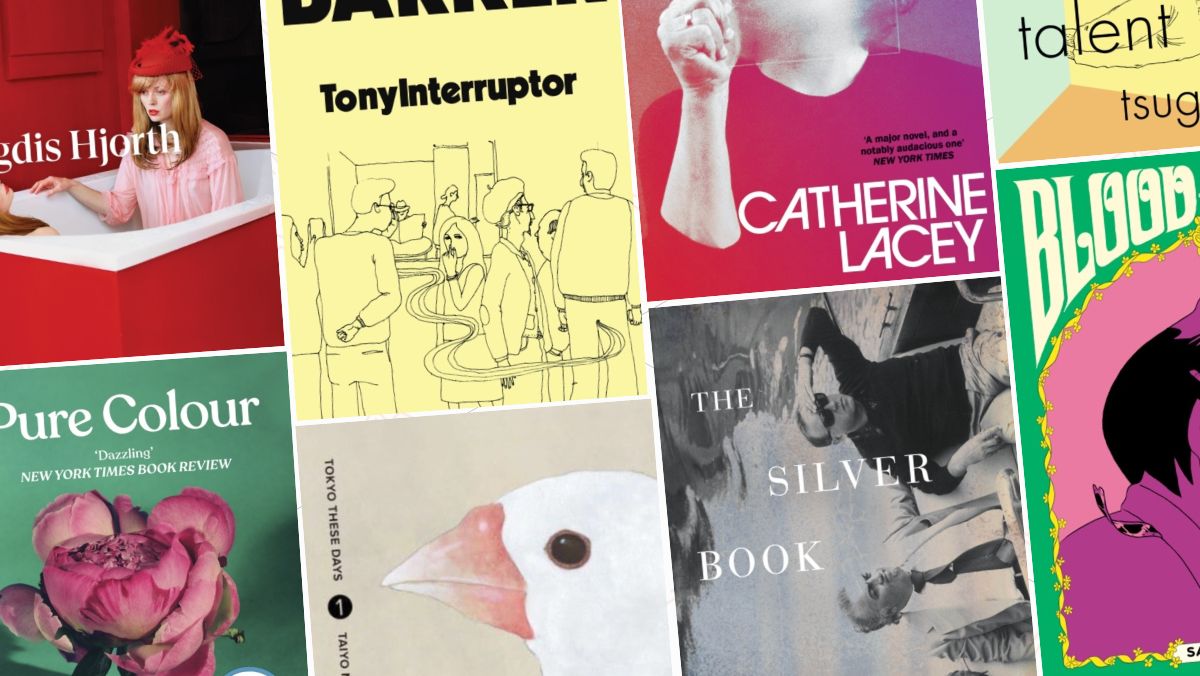
Capturing the delicious angst of the creative act, documenting the collision of art and real life in painful detail: these books will scratch an itch for anyone who finds the lives of artists endlessly fascinating. You’ll find mostly fictional artists here, but also the occasional nod to real-life figures too (especially in Biography of X – get your pop culture trivia hats on folks!)
Tokyo These Days, by Taiyo Matsumoto (translated by Michael Arias)

All three volumes of Tokyo These Days by Taiyo Matsumoto easily rank alongside the best things I read in 2025 and I’ve since put Matsumoto’s entire oeuvre on my to read list.
Tokyo These Days follows legendary manga editor Shiozawa on his quest to curate the perfect manga. First, he leaves the manga business entirely as a way of atonement for low sales on his recent magazine. He gets a dealer to come and price up his extensive collection, but changes his mind last minute, instead vowing to redeem himself and many of his favourite artists (many of whom are no longer working or who have lost the love of the medium) by creating something truly pure and perfect. What follows is a contemplative, cinematic journey through the interconnected world of artists, writers, readers, editors, publishers and booksellers in Tokyo–some young and green, others washed up and past their best–as they struggle with what it means to create something artistically true or to create something that might be the next big things. It’s a beautiful manga with a great sense of place and a big cast of obsessive artistes slogging away to meet their gruelling deadlines. All in the name of ART!
TonyInterruptor, by Nicola Barker

Beginning with a heckling incident at an improvisational jazz gig in which the titular character asks the performers if they can describe themselves as ‘honest’, the novel spools into a hilarious and anxiety-inducing dissection of the nature of creativity. Can improvisation ever be truly spontaneous? What is the internet doing to art? Why shouldn’t we stand up in public and shout? The dialogue is painfully recognisable to anyone who has felt their opinions on culture carry a smidge more weight than others (not us, obviously), and Barker’s facility with hashing out riddle-like social issues with humour and invention is nothing short of virtuosic.
The Man Without Talent, by Yoshiharu Tsuge (translated by Ryan Holmberg)

Yoshiharu Tsuge’s first full-length graphic novel to be translated into English (though the last he wrote in his career) is an unrelentingly bleak but completely beautiful artifact, an autobiographical reckoning with the ultimate futility of doing anything creative with your life. It’s lols all round, as you can imagine. We follow a version of the author as his desire to create comics ebbs and flows, but not as much as his relationship with his increasingly frustrated family who depend on him for support but can’t access his inner life. Tsuge’s cipher scrabbles about in the muddy waters to the west of Tokyo to find rocks to sell rather than actively seeking lucrative drawing work, and he’s captured in a kind of professional paralysis that creative folks will find only too relatable. Strange and beautiful, internal yet expansive.
A State of Siege, by Janet Frame

Instant classic. A “no plot all vibes” book in some senses. On paper, not a lot happens. And yes, there are a lot of vibes. But actually I think that undersells it because there’s just so much tension, and angst and melancholy and depth.
Our protagonist Malfred Signal, a retired art teacher, moves from her home on New Zealand’s south island up to a small island in the north following the death of her mother. It’s a pretty isolated community where she plans to spend the rest of her days away from other people painting the landscape, but she’s warned upon arrival of a certain “element” on the island. What follows is one long, incredibly tense night under siege: by her memories and imagination, by her past traumas, and, most threateningly of all, by a constant loud knocking at the door. The whole book more or less takes place within Malfred’s head, following her thoughts and her dreams as they spiral one way and another against a background of constant knocking—often veering into surprisingly philosophical art theory and the nagging suspicion that she quashed the creativity of her students. Utterly compelling, FFO Virginia Woolf, stormy weather…
Blood of the Virgin, by Sammy Harkham

This graphic novel is nothing short of a masterpiece. Honestly, it’s going to join the canon of “absolute mega-hits” alongside Fun Home, Maus, that kind of thing.
I knew nothing about Sammy Harkham or this comic up until recently, but it turns out it’s been almost two decades in the making, released in partly serialised format in a regular comics anthology. You can see why – it’s clear how much work went into this. We follow Seymour, an Iraqi Jewish ex-pat living in 1970s LA as a frustrated and disregarded film editor, mostly for exploitation films – but with ambitions to write and direct his own horror flick: The Blood of the Virgin.
His trials in bringing this movie to fruition make up the brunt of the action, but underlying his artistic struggles are his personal travails: his unsuccessful marriage to Ida, his infant son from whom he feels his estranged, Jewish identity, the recent history of the Holocaust. It’s seriously powerful, and feels as much of an accomplishment for the comic format as Maus was.
Biography of X, by Catherine Lacey

Any attempt to sum up Biography Of X in a pithy manner will only get us into trouble, but let’s give it a go? A fictional biography of a fictional artist, written by the fictional artist’s actual partner, all presented as a hermetically self-contained non-fiction document, but one that takes place in an alternative-history version of the United States and weaves in and out of history as WE understand it by employing a revolving cast of pop culture figures who ghost in and out of the story (including: David Bowie! Brian Eno! Connie Converse!).
It’s also possibly the most beautifully written, ambitiously staged and emotionally gutting book of the year, which is all the more ridiculous considering the gargantuan scope of the novel. This is as much a chronicle of a world that almost existed as much as it is a prodding of the entire genre of biography, its ethical and moral ickiness. An absolutely monolithic expression of a singular vision which we cannot recommend highly enough.
Outsider Everywhere, by Mercedes Halfon (translated by Rahul Bery)

If you want to spend 200 pages in a little slice of midcentury Argentina, this is the book for you. Witold Gombrowicz lands in Argentina just before war breaks out in Europe, and decides not to go back. He’s written some books in Polish, but no one on that side of the Atlantic has any idea who he is. He’s penniless, has no friends, he speaks terrible Spanish, and none of the Latin American literary elite want very much to do with him, partly due to him coming across to almost everyone as pretty unpleasant. He’ll come to assemble a band of young followers who become increasingly obsessed with him, be nominated for the Nobel Prize, and considered in retrospect to be an Argentinian writer, though in the meantime he pretends to work in a bank while actually writing more novels and diaries.
Outsider Everywhere is as much a biography of Witold Gombrowicz through the lens of Argentina as it is a biography of a specific time and place through the lens of Gombrowicz, with all the strife and eccentricity that comes with it.
If Only, by Vigdis Hjorth (translated by Charlotte Barslund)

If Only is probably the best existing argument for never embarking on a relationship in your entire life. It is the ultimate in doomed romance, wrongheaded desire, irrational impulses and mangled emotions, and we couldn’t love it more. If you fancy yourself as someone who actively seeks out the unhinged in fiction, then Vigdis Hjorth has seen you coming and will make you regret ever expressing a fondness for such a frivolous thing as ‘an emotional experience’.
Ida and Arnold, the wretchedly entwined couple at the centre of this novel (and the aforementioned tortured artists), will if nothing else give you a good few excuses to turn to your own beloved partner, should you have one, and say ‘OK but I’m not that bad.’ Exceedingly recommended.
Pure Colour, by Sheila Heti

A prestigious school for budding art critics, a store which sells exquisitely beautiful and expensive lamps, a leaf.
These are perhaps the only tangible things to grasp onto in Pure Colour, the latest of Sheila Heti’s characteristically philosophical, abstract and utterly brilliant novels. Pure Colour is mostly internal and small scale – sometimes so small that a chapter takes place inside a single leaf – and yet somehow grapples with some of the most fundamental questions of existence, art, criticism, love, creation.
Second Place, by Rachel Cusk

In Second Place, a woman is overcome by the work of a controversial painter and invites him to stay in her cottage along the coast. The vigour with which the artist disrupts the woman’s life is apparent not only through his unruly and demanding manner, but also the enigmatic quality of his artwork, and the inescapable feeling that, if she were to look closer, the woman might discover something horrifying about her own state of being. Delivered in Cusk’s typically detached style, Second Place tears apart notions of artmaking and womanhood.
The Silver Book, by Olivia Laing

In 1970s Venice, a troubled English artist and a flamboyant Italian production designer meet in a gallery. The artist, Nicholas, has fled a dark past in London, while the designer, Danilo Donati, is preparing for a production of Casanova, Frederico Fellini’s ode to decadence and excess. The two men fall in love and Danilo enlists Nicholas to be his assistant. But while Nicholas finds the extravagances of Casanova wild and exciting, he is disturbed by Danilo’s latest project, Salò, a visceral horror directed by the enigmatic Pier Paolo Pasolini.
It seems almost redundant to describe a novel about cinema as ‘visual’, yet I can’t help but marvel at the vividness with which Laing depicts the art of filmmaking. From blood-soaked garments to Caravaggio-style set pieces, it is no wonder Nicholas struggles to distinguish reality from illusion as he walks through the sets of the famed Cinecitta. And yet, at the heart of the novel is this delicate love story between Nicholas and Danilo, whose deep intimacy, while frenzied and passionate within the confines of their hotel room, is relegated to furtive glances and stolen kisses under the gaze of an aggressively homophobic society.
Much of the novel’s reality is dark and gritty, with an impending sense of dread as the country’s politics lurch further right. Yet, in a poetic, controlled style, Laing writes of a world from which beauty is created – in Fellini’s case, as a form of escapism, and in Pasolini’s, to reflect the brutality of the everyday.
Street-Level Superstar: A Year With Lawrence, by Will Hodgkinson

If you’re not familiar with the alternative pop icon Lawrence Hayward, known simply as Lawrence, then Lawrence himself may have a thing or two to say about that. In this brilliantly inventive biography, journalist Will Hodgkinson shadows Lawrence on long walks around London and records their conversations, noting down Lawrence’s at-times painfully honest feelings on his – as he sees it – unfair omission from the pantheon of music legends. The two converse, relate and bicker, while delving into Lawrence’s feted (though not lucrative) musical history with bands like Felt, Denim and his newest project, Mozart Estate. But knowledge of the oeuvre is, comfortingly, in no way a prerequisite for hugely enjoying this book.
So often the success of a great work of non-fiction relies on its ability to make the niche universal, the seemingly insular and unwieldy suddenly approachable and addictive, which is precisely the trick Hodgkinson has perfected in Street-Level Superstar. Taking the extended lyrical profile journalism of Gay Talese as a starting point, Hodgkinson revels in the personal discomfort he and his subject encounter together as they attempt to find a gallery glamorous enough to house a large wax statue of Lawrence’s head (sometimes it is necessary to remind yourself that, yes, this is a work of non-fiction). The result is a hilarious and melancholy assessment of a life devoted to art, and what that can really mean for the life in question.